


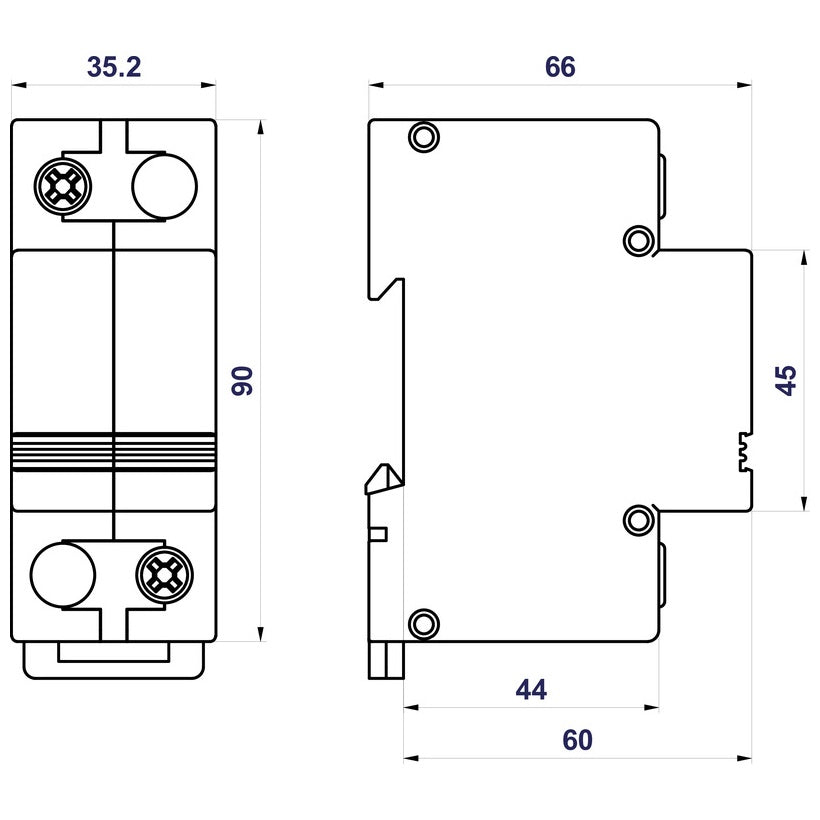
The HLA50-255 from Hakel is a Type 1 surge protection device designed to manage high energy transients, particularly those associated with lightning strikes entering a low voltage installation. It is typically installed at the main switchboard or service entry point, where it acts as the first level of protection by diverting surge energy safely to earth before it can propagate into the internal electrical network.
In practical applications, this device is used in environments where there is a higher risk of lightning exposure or major switching disturbances. This includes industrial facilities, utilities, data centres, hospitals, and sites equipped with external lightning protection systems. It is particularly relevant at the transition between external and internal zones (LPZ 0 to LPZ 1), where the bulk of surge energy needs to be intercepted.
Technically, the HLA50-255 operates using spark gap technology, which differs from the MOV-based approach used in Type 2 devices. Under normal operating conditions, the device remains inactive with negligible leakage. During a surge event, it creates a controlled discharge path, allowing high impulse currents (10/350 µs waveform) to be safely conducted to earth. Once the surge has passed, the arc extinguishes automatically, and the device returns to its standby state without degradation typically associated with MOV components.
From a system design perspective, the HLA50-255 forms part of a coordinated surge protection scheme. It is intended to handle the initial high energy surge, after which downstream Type 2 and Type 3 SPDs further limit residual voltages to levels suitable for sensitive equipment. This layered approach ensures both robustness and longevity of the overall protection system.
For effective performance, installation practices are critical. The device should be connected with short and low-impedance conductors, and the earthing system must be properly designed to ensure efficient discharge of surge energy. Consideration should also be given to upstream protection coordination and, where required, remote signalling variants can be used for integration into monitoring or SCADA systems.
In essence, the HLA50-255 is used where the objective is to absorb and safely dissipate the highest levels of surge energy at the entry point, ensuring that downstream systems and equipment remain protected from damaging overvoltages.